Did the fire leave soot in my Syosset home and can SERVPRO of Hicksville / Plainview help
Government / Public Services
Oh, the unexpected trials of owning a home! Why is the smoke smell still in my Hicksville house and can SERVPRO of Hicksville / Plainview fix it . One minute youre cozily sipping on a cup of tea, and the next, youre wondering if that faint smell of smoke meant trouble. If youve ever found yourself pondering Did the fire leave soot in my Syosset home? youre not alone. Many homeowners face this dilemma, and its not always easy to determine the extent of the damage. But fret not, because there are solutions out there-SERVPRO of Hicksville / Plainview might just be your saving grace.
First off, lets talk about soot. Its not just an unsightly nuisance; it can be a real pain (health-wise too). Soot particles, which are the remnants of incomplete combustion, can cling to walls, ceilings, and just about any surface in your home. They dont just make things look dirty; they can also affect indoor air quality. You probably dont want that lingering around your family, do you?
Now, you might be thinking, Oh no, my beautiful Syosset home! But dont panic just yet! SERVPRO of Hicksville / Plainview has got your back. Theyre not new to this game, and theyve helped countless homeowners just like you. Theyre pros at knowing what to look for and how to handle the aftermath of a fire.
* Emergency fire response team
15. Fire damage restoration near Farmingdale
46. Soot residue removal Hicksville
PSEG Long Island (local utility provider)
With their expertise, they can assess the damage and clean up your home (better than youd expect!).
You might wonder, Cant I just clean it myself? Well, its not that simple. Soot is notorious for being stubborn. Regular cleaning methods may not cut it, and you could end up spreading the mess instead of removing it. Plus, there are safety concerns-no one wants to inhale those particles. So its best to trust professionals who have the right tools and knowledge.
SERVPRO of Hicksville / Plainview doesnt just clean; they restore. Theyre trained to deal with fire and water damage, which means they know what theyre doing. They can help you navigate the insurance process, too (which is always a bonus). Its not just about getting rid of soot; its about making your home feel like home again.
In conclusion, if youre sitting there scratching your head and thinking, Did the fire leave soot in my Syosset home? and Can SERVPRO help? the answer is likely yes to both. Dont let the thought of soot get you down. Let the pros handle it, and youll be back to enjoying your cozy home in no time. After all, lifes too short to stress over soot!
This section needs expansion. You can help by adding to it. (July 2024)
Hamlet namesake Valentine Hicks[2] was the son-in-law of abolitionist and Quaker preacher Elias Hicks, and eventual president of the Long Island Rail Road. He bought land in the village in 1834 and turned it into a station stop on the LIRR in 1837.[2] Hicksville was founded accidentally when a financial depression brought the LIRR to a stop at Broadway, Hicksville. The station slowly grew and though it started as a train station, it turned into a hotel then a real estate deal,[3] even becoming a depot for produce, particularly cucumbers for a Heinz Company plant. After a blight destroyed the cucumber crops, the farmers grew potatoes. It turned into a bustling New York City suburb in the building boom following World War II.[4][5]
In 1953, Hicksville attempted to incorporate itself as the Incorporated Village of Hicksville.[6] Many residents felt that by incorporating as a village, the community would be run more effectively than by the Town of Oyster Bay. A petition had been signed with 6,242 signatures from residents in favor of the plan.[6][7][8]
However, these plans were unsuccessful, and Hicksville remains an unincorporated area of the Town of Oyster Bay to this day, as of 2023.[9][10]
According to the United States Census Bureau, the CDP has a total area of 6.8 square miles (18 km2), of which 6.8 square miles (18 km2) is land and 0.15% is water.[11]
The climate is borderline between hot-summer humid continental (Dfa) and humid subtropical (Cfa) and the local hardiness zone is 7a.[12] Average monthly temperatures in the village center range from 31.9 °F in January to 74.7 °F in July.[13]
Metalab Equipment Company, a division of Norbute Corp, made laboratory furniture and cabinetry.[14] Alsy Manufacturing manufactured electric lamps and lampshades from 1975 through 1991.[14]
The Rubber Company of America (RUCO) built a manufacturing site in 1945. RUCO Polymer Corp. (Hooker Chemical Company) manufactured plastics, latex, and esters. Occidental Chemical Corporation (OCC) owned and operated this site from 1966 to 1982. The site was purchased by Sybron Corporation, then in 2000, the Bayer Corporation (Bayer MaterialScience) purchased the Hooker Ruco facility and in 2002 decided to close the facility. The facility was a freight customer of the Long Island Rail Road and New York and Atlantic Railway, served by a spur track off the Main Line next to the grade crossing at New South Road.[15] The site was used for the production of polyester from 1982 until 2002. The LIRR removed the switch during track work sometime after the closure and demolition of the buildings on the property. The property remains fenced-off and vacant currently.[16]
The presence of a major LIRR hub means that Hicksville developed as a major bedroom community of New York City. The LIRR has a team yard on West John Street, just east of Charlotte Avenue, served by the New York and Atlantic Railway, for off-line freight customers receiving or shipping cargo by rail to anywhere in the North American rail network.
Hicksville's North Broadway, positioned in the center of Nassau County, developed into a significant retail center. North Broadway was home to the Mid-Island Shopping Plaza (now known as Broadway Mall), a 156,000-square-foot Sears department store and auto center (which closed in 2018)[17] and various other restaurants and retail stores.[18]
Hicksville is home to a number of South Asian grocery stores, clothing shops and restaurants, due to its large proportion of immigrants from India, Pakistan, and Bangladesh.[19][20]
For the period 2017–2021, the median annual income for a household in the CDP was $123,230. The per capita income for the CDP was $46,504. About 4.1% of people were below the poverty line.[22]
By 1996 there were around four to five restaurants in Hicksville serving South Asian cuisine, and this started the ascent of a "Little India" there.[23]
Between 2010 and 2020, Asian populations in Hicksville grew faster than the population as a whole.[20] During this period, Hicksville's Asian population grew from 8,139 to 14,178, comprising 32.3% of the town's population.[20] By 2020, Hicksville had become "a hub" of Indian-American life, with multiple South Asian grocery stores, clothing shops, and restaurants, serving the religious, economic, financial, and cultural needs of its many South Asian residents.[20]
As an unincorporated hamlet within the Town of Oyster Bay, Hicksville is governed directly by the town's government, which is seated in Oyster Bay.[10]
Hicksville is primarily located within the boundaries of the Hicksville Union Free School District.[10][25] However, a small part of the hamlet's southeastern corner is located within the boundaries of the Bethpage Union Free School District while a small portion of the hamlet's northeastern corner is located within the boundaries of the Syosset Central School District.[10][25] As such, children who reside within Hicksville and attend public schools go to school in one of these three districts depending on where they live within the hamlet.[10][25] In 2023, Hicksville High School was ranked in the top 30% of New York schools by the National Center for Education Statistics.[26]
Hicksville is located within the boundaries of (and is thus served by) the Hicksville Library District, the Bethpage Library District, and the Syosset Library District.[10] The boundaries of these three districts within the hamlet roughly correspond to those of the three school districts.[10]
The Hicksville Fire Department's headquarters in 2019
Hicksville's fire protection is provided by the Hicksville Fire Department.[10] Its police protection comes from the Nassau County Police Department's 2nd and 8th precincts, as well as the MTA Police and Nassau County Auxiliary Police.[10]
^ abcdPhillips, Ted (September 8, 2021). "Asians outpace other residents in Jericho and Hicksville, census shows". Newsday. Retrieved June 17, 2023. In Hicksville, where South Asian grocery stores, clothing shops and restaurants dot the streetscape, the Asian population grew to 14,178 in 2020 from 8,139 a decade earlier, according to census data. Asians are the second largest group, comprising 32.3% of the population compared with 43.5% for whites.
^National Polish-American Sports Hall of Fame. "Mitch Kupchak". polishsportshof.com. Archived from the original on March 4, 2024. Retrieved March 4, 2024.
Throughout the district's existence, it was the subject of bipartisan criticism by both taxpayers and government officials, who cited the district's inefficiencies, taxpayer cost burdens, and maintenance issues, amongst other things.[1][2]
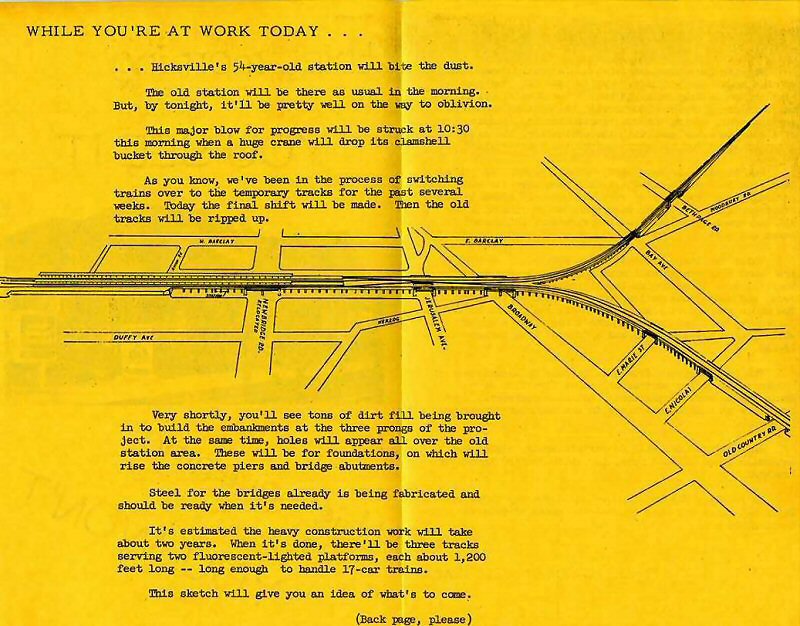
The Hicksville Escalator District was established on September 15, 1964, as a result of the reconstruction of the Hicksville station; the station, which had previously been at-grade, was raised onto an elevated structure through a grade crossing elimination project executed by the New York Public Service Commission.[1][3][4][5][6] The district was created by the Town of Oyster Bay in order to pay for & maintain the rebuilt station's two escalators between the street and the platforms.[1][2][3][7] The escalators went into service in 1966.[8][9][10]
Not long after the establishment of the district and the installation of the escalators, issues over costs & maintenance arose. Disputes between the town and the Metropolitan Transportation Authority hindered the district's ability to adequately maintain the escalators, which were subjected to frequent, chronic breakdowns and were poorly shielded from the elements.[8][10] In an attempt to mitigate weather-related breakdowns, the escalators were enclosed by the town in 1969 to shield them from the elements, but chronic breakdowns and other issues persisted.[8][10]
By January 1977, seeking to abolish the district and allow the escalators to be maintained more efficiently, Oyster Bay officials were negotiating with the Metropolitan Transportation Authority for that agency to purchase the escalators for $1; this would enable the district's elimination, the town's taxpayers to be relieved of the cost burdens, and the improvement in the station's efficiency.[2][7][10] That May, the Oyster Bay Town Board voted in favor of this proposal, spearheaded by Town Supervisor John Colby.[2][7] The extensive talks between the town and the MTA broke down later that year, as a result of the MTA demanding the town first repair the escalators to a state of good repair – and pay for the replacement the handrails – before the execution of the transfer could be completed; this dispute coincided with the town spending $40,000 (1978 USD) to repair the steps on the escalators.[2] The prerequisite was viewed by town officials & taxpayers as an undue tax burden upon district residents, as then-Deputy Town Supervisor Robert Schmidt stated in a 1978 Newsday article on the matter.[2] Schmidt also argued that, as a significant amount of passengers at the station – the LIRR's busiest east of Jamaica – resided outside of the district, it would be more appropriate for the MTA to own, operate, and maintain the escalators; district residents were paying an escalator tax of 1.4 cents per $100 in valuation at the time.[2] It was further argued by Supervisor Colby that it was more appropriate for the MTA to assume ownership & maintenance responsibilities than leave them to the town, as the escalators were a service for commuters at an MTA-owned train station, served by an MTA-operated commuter railroad.[8]
By February 1978, bills in the New York State Legislature were proposed as a result of the breakdown in negotiations between the town and the MTA, which spurred the need for legislative action to settle the matter; the bills would effectively dissolve the district and transfer the escalators' ownership & maintenance responsibilities to the MTA – and would also enable that agency to replace them.[2][11] The bills also allowed for the allocation of up to $700,000 (1978 USD) for the installation of escalators at the Floral Park, Lynbrook, and Valley Stream stations.[2] The bills received bipartisan support and subsequently passed; Senator Norman J. Levy (R–Merrick) sponsored the State Senate bill, while Assemblyman Lewis J. Revoli (D–Old Bethpage) – a vocal critic of the district – sponsored the State Assembly bill.[1][2][8] About this time, Levy also sponsored a separate bill to abolish the Baldwin Escalator District – a similar district in Baldwin to maintain that community's station's escalators and the only other such district in Nassau County.[2]
On October 30, 1979, with the New York State Legislature's approval, the MTA took over control of the station's escalator's from the district.[1] At the time, district residents were paying an escalator tax of 1.9 cents per $100 in valuation – an increase from a tax of 1.4 cents per $100 in valuation in 1976, caused by rising maintenance costs.[1][9][10] That same day, upon the transfer, the Hicksville Escalator District officially dissolved.[1]
The Hicksville Escalator District was governed by the Town of Oyster Bay.[1][9][10] It was funded through taxes on properties located within the district's boundaries. The district's expenditures included paying for the construction and maintenance of the escalators – in addition to the salary of one full-time escalator serviceman.[1][10]
DIVIDE Interlocking tower, located just east of the station
Hicksville station's first depot opened on March 1, 1837, and it served as the temporary terminus of the LIRR.[4] Both the station and the eponymous hamlet were established by Valentine Hicks – the son of an abolitionist preacher who also briefly served as President of the LIRR.[4]
In 1841, the Main Line was extended east from Hicksville to Farmingdale, after a delay caused by the depression that had begun with the Panic of 1837.[4]
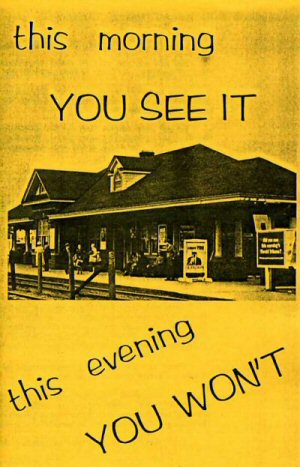
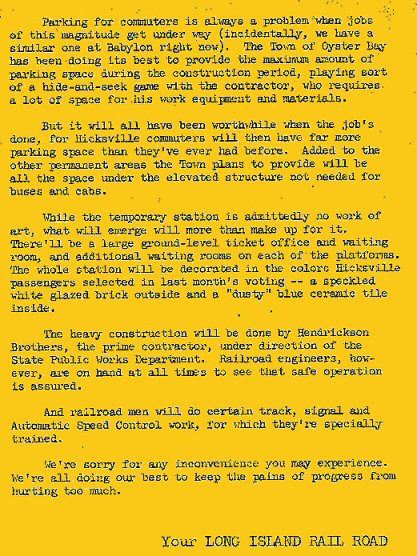
In 1854, the station gained a line known as the Hicksville and Syosset Railroad that later became the Port Jefferson Branch of the LIRR.[4] Ten years later, on July 15, 1864, Hicksville's first depot burned down. A second depot opened in September 1873, and was moved to a private location in 1909. The third depot opened on October 30, 1909, and was razed in November 1962 as the current elevated structure was being built.[4][5][6] The elevated station opened on September 12, 1964.[4][6][7]
In 1965, an eagle sculpture from the original Penn Station, which had recently been demolished, was moved to the Hicksville station. The sculpture was subsequently installed in the station's parking lot, where it remains standing today.[4][8]
In October 1970, third-rail electrification on the Main Line was extended from Mineola through Hicksville to Huntington[9] thereby introducing direct electric train service to Penn Station (Hicksville customers had previously been required to change trains at Jamaica).[9] The first electric train to serve the Hicksville station ran on October 19th of that year.[9]
On October 30, 1979, the MTA took over control of the station's escalators from the Hicksville Escalator District – a special district responsible for maintaining and paying for the escalators at the station; the controversial district was dissolved upon this transfer of ownership.[10]
The station underwent a full renovation beginning in early 2014.[11] The $121 million renovation included replacing station platforms, escalators, elevators, waiting rooms, canopies, and lighting. Security cameras were also added during the renovation.[11] Construction was estimated to last through 2017, and was expected to be completed by August 2018.[11][12][13] Platform A was the first platform to be rebuilt, reopening in September 2017.[14] The electrical substation at Hicksville station will be replaced as part of the Main Line third track project.[15] The rehabilitation project was officially completed in September 2018.
Generally, Platform A serves westbound trains and Platform B serves eastbound trains. Track 2 operates with the flow of rush hour, handling westbound trains in the morning and eastbound trains in the evening, though some westbound trains will use Platform B. Most Montauk Branch trains pass through the station without stopping. East of the station, the Port Jefferson Branch splits from the Main Line at DIVIDE Interlocking.
In January 2025, it was officially announced that a new Long Island branch of Amtrak's Northeast Regional, running east to Ronkonkoma via the LIRR's Main Line, would serve the Hicksville station, with an intermediate stop at Jamaica east of Penn Station.[3] The year prior, Amtrak conducted a study of the new service through a $500 million federal grant.[16] As of January 2025, Amtrak service is anticipated to begin in 2028.[3]


![[icon]](https://www.wikipedia.org/wiki/File%3AWiki_letter_w_cropped.svg)